
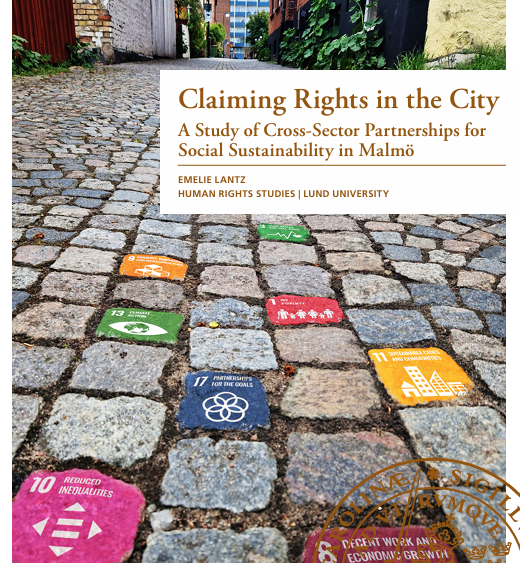
By Emelie Lantz, Lund University, Human Rights Studies
Imagine crossing a single street and witnessing a stark shift in living standards, life expectancy, and economic security. In many post-industrial cities, these geographical inequalities are very visible. In Sweden’s third-largest city, Malmö, this reality forms what researchers call a “dual city”: on one side, a thriving, eco-friendly knowledge hub celebrated globally for its sustainability awards; on the other, deep-seated socio-economic segregation and rising inequality.
To bridge this gap, cities like Malmö increasingly turn to global frameworks like the United Nations’ 2030 Agenda, merging the Sustainable Development Goals (SDGs) with local strategies for social sustainability. Collaboration with civil society organisations (CSOs) is widely seen as the magic wand to mend these fractures. But what happens when global norms of social sustainability and human rights are translated into local collaborative practices?
My doctoral research, Claiming Rights in the City: A Study of Cross-Sector Partnerships for Social Sustainability in Malmö, examines this question. By exploring collaborative projects between the City of Malmö and local civil society organisations, the study examines how urban partnerships manage the tension between fulfilling human rights and pursuing measurable, short-term project goals.
The Trap of “Projectification” and “Imposed Participation”
Today, urban governance is heavily shaped by what scholars call “projectification”—an intense reliance on temporary work formats, short-term funding, quantifiable targets, and a constant demand for innovation and testing new things. While projects are flexible and visible, they are rarely suited to solving deep-rooted structural problems like segregation.
In my study, I have discussed the risk that projects aiming to be citizen-driven can instead lead to “imposed participation”. Even if projects are intended to be citizen-driven, short timelines and targeted funding can exclude important aspects of participation. Instead, residents are implicitly expected to participate and prove their worthiness to be considered rights-bearers—getting their needs met only if they participate in specific projects and act as good citizens. Rather than dismantling inequality, this transactional approach reinforces existing social hierarchies and leaves residents tired of unrequested initiatives with little visible impact.
Furthermore, the city’s bureaucratic demands and focus on predetermined, quantifiable metrics often transform civil society organisations from independent advocates into mere service providers. Small, grassroots groups struggle to navigate the municipal bureaucracy, leaving well-resourced, professionalised organisations to secure formal partnerships while sidelining residents’ voices.
Moving Toward a Progressive Human Rights Practice
If cross-sector partnerships are to spark real, transformative change, we must rethink how we understand both human rights and participation. Human rights should not be treated as a static checklist of basic needs handed down from above, nor as objectives in a bargain to create good citizens.
Instead, we need a progressive interpretation of human rights rooted in the active practice of claiming rights. Drawing on Henri Lefebvre’s classic “right to the city” framework, rights are fundamentally about collective political struggle and the power of inhabitants to help shape the urban spaces they live in.
True collaboration requires local authorities to share power, listen deeply to residents (especially more marginalised groups), and build long-term platforms that support civil society’s role as independent representatives of rights-holders.
Takeaway for Readers
When we talk about sustainable urban development, we must look beyond the glossy brochures of eco-modernist success and ask questions about power and justice. Are our social sustainability initiatives genuinely empowering residents to reshape their cities, or are they simply masking structural inequalities behind a veneer of participation? To leave no one behind, we must ensure that cities are built with their residents, not just for them.
Read the full dissertation: Lantz, Emelie. (2026). Claiming Rights in the City: A Study of Cross-Sector Partnerships for Social Sustainability in Malmö. Lund University.

Emelie Lantz was a doctoral student at the Human Rights Studies at Lund University and member of the Lund University’s Graduate School for Agenda 2030. Emelie completed her PhD in September 2026, successfully defending her doctoral thesis at Lund University.
