
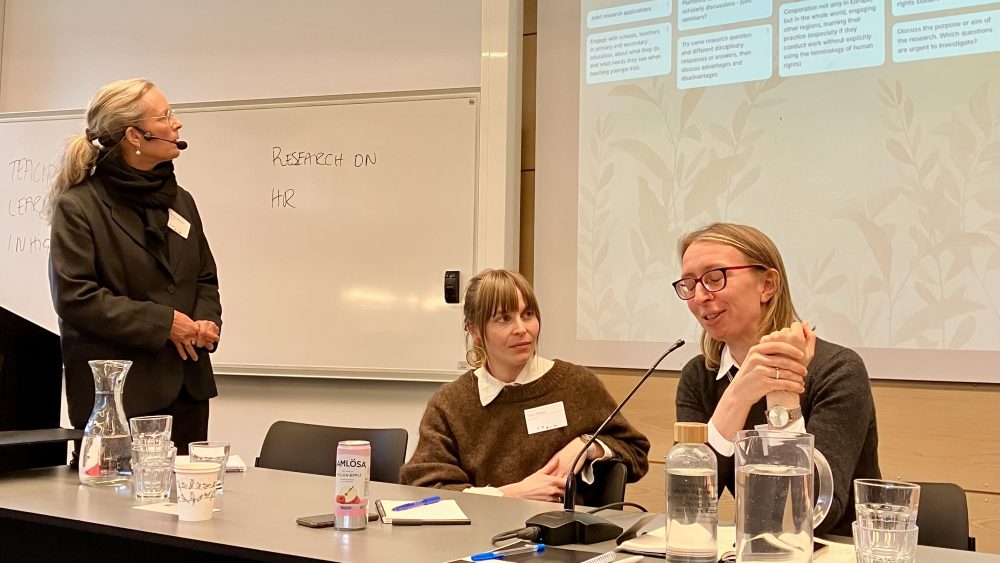
Frida Nilsson reflects on the conference Human Rights in Higher Education, organized by the Lund University Profile Area Human Rights, 19-20 October 2023. Frida is a PhD in Human Rights Studies and specializes in human rights education. She has just completed a review of human rights teaching in Master courses and programs at Lund University.
Although human rights education at universities is no longer new to the academic family in Sweden – the Lund University interdisciplinary Bachelor program in Human Rights Studies celebrates 20 years this year! – we are yet to explore human rights education in higher education. The LU Profile Area Human Rights organised a conference on this theme on 19-20 of October 2023. For the first time teachers and researchers in human rights from Swedish universities as well as prominent international human rights education scholars came together with representatives from the Swedish Institute for Human Rights and the Raoul Wallenberg Institute to discuss this question: what is it that we teach when we teach human rights? The occasion served, for me, as an invaluable exchange of knowledge and experience in teaching human rights and researching human rights education.
Among the themes discussed were human rights as a possible profession, what “interdisciplinarity” means in research and teaching, what interdisciplinarity in research and teaching can accomplish and what it cannot, and how resilient human rights education in higher education can be given the political polarisation and intrusions on academic freedom today. This blogpost will not do justice to the many rich discussions and themes, but I will reflect briefly on what has stayed with me, as teacher and researcher in human rights education, and what I found particularly thought provoking. This academic year, I am immersed in questions of teaching human rights, human rights pedagogy, content, and purpose, and I found myself looking for answers regarding usefulness and purpose of human rights education.
The first day of the conference reflected a Swedish perspective on the educational purpose and aims of a human rights education – what are we teaching for, and for what are the students learning? Christina Johnsson (Malmö University) opened the conference with her report on an emerging human rights profession. This presentation in combination with other panel talks and discussions gave food for thought as it showed that human rights competences are integral to many professionals in public sector, while employers seemed to look for generic competences which characterises a good bureaucrat and co-worker. This tapped into the theme of what kind of human rights education we are offering at Lund University. I presented the results of my review of programs and courses in the field of human rights at our university, acknowledging that “human rights education” is a wider phenomenon than program and courses that explicitly have “human rights” in the title. On this broad understanding, I have found that Lund university offers three types of human rights education:
- Concept-oriented education. This refers to courses and programs where human rights are at the core: human rights are the object of study, the focal point that make specific topics and issues relevant for the education.
- Implementation-oriented education. This refers mainly to professional degree programs that involve application of human rights standards, for example the UN Convention on the Rights of the Child. Human rights are viewed here primarily as a matter of legal knowledge and institutional ethical practice, and human rights are taught as a complement to the main subject. To this category belong programmes where practical implementation of relevant human rights standards is part of the students’ future careers.
- Purpose-oriented education. This refers mainly to programs where human rights as a multidisciplinary field at some points or on specific issues are perceived to provide a relevant perspective on the topic at hand. These programs usually have a focus on social justice and use human rights to deepen or broaden the understanding of their subject.
This typology reflects an inclusive way of understanding human rights education, as well as a multidisciplinary way of thinking about what human rights are.
On the second day of the conference, we discussed international perspectives. I found that my typology could be put in contrast to a model presented by Orla Ní Cheallacháin (Global Campus of Human Rights, Venice). According to the model, developed by Utrecht University, multidisciplinary research and education usually start with a disciplinary grounding and basic knowledge related to specific disciplines, and then move on to perspective-taking, that is, using the different disciplinary groundings to analyse whatever matter is at hand. In human rights degree programmes, the disciplinary groundings might differ slightly but usually include law, ethics, philosophy, and history. On to this model, education programs then proceed to finding common ground while making the differences and similarities in conceptions and language explicit, and then finally integrate these different perspectives.
My generation of human rights scholars, who are educated within human rights degree programmes that are already multidisciplinary, skipped the first step – the disciplinary grounding. This also goes for the students I now teach, as they are expected to start with the concept of human rights as the basis for other perspectives. This begs the question if we, by doing multidisciplinary human rights education, are doing our students a disservice by not making explicit what the disciplines are. It also makes me reflect on when a multidisciplinary field turns into a new discipline, what it takes to get there, and if it’s a good thing or not. Even though multidisciplinary human rights education is established in the world of higher education, it was clear from the conference that the step towards it becoming a discipline in its own right is not yet taken.
This leads me back to the question of what we are educating for. The discussions at the conference kept coming back to how we equip our students through human rights education. One aspect of human rights teaching that many programs at LU have in common is educating human rights professionals that can handle the daily challenges of respecting, fulfilling and protecting human rights in their future public sector function or capacity, knowing the limits of institutional reach, and to implement political decisions. However, as was reflected throughout our discussions, the purpose and need for human rights scholars is not so much about providing the public sector with efficient bureaucrats who know how to implement policy, but rather to create critical civil servants with integrity to protect the fundamental values of democracy and human rights, ready to use their knowledge to raise the alarm when human rights standards are challenged or not met. A take-away for me is that we need students to reflect on the complexities and challenges that come with the changing democratic landscape. I believe human rights education is a way forward.



Comments